Key Terms — Functions & Procedures
UDF
A custom scalar function that returns a single value per input row. Can be written in SQL, JavaScript, Python, or Java.
UDTF
A custom function that returns a set of rows (a table). Called with TABLE() in the FROM clause.
Stored Procedure
A procedural block that can perform DDL/DML, control flow, and return a single value. Supports SQL, JavaScript, Python, Java, and Scala.
External Function
A UDF that calls an external API (via API Gateway + Lambda/Cloud Function). Snowflake sends data out and receives results back.
Owner's Rights
Default for stored procedures — executes with the privileges of the procedure owner, not the caller.
Caller's Rights
Optional mode where the procedure executes with the caller's privileges. Set with EXECUTE AS CALLER.
UDFs (User-Defined Functions)
UDFs are scalar functions — they take input values and return a single value per row. They are used in SELECT, WHERE, and other expression contexts.
1-- Simple SQL UDF2CREATE OR REPLACE FUNCTION mask_email(email VARCHAR)3RETURNS VARCHAR4LANGUAGE SQL5AS6$$7CONCAT(LEFT(email, 2), '****@', SPLIT_PART(email, '@', 2))8$$;910-- Usage11SELECT mask_email('john.smith@company.com');12-- Result: jo****@company.com1-- JavaScript UDF2CREATE OR REPLACE FUNCTION calculate_bmi(weight_kg FLOAT, height_m FLOAT)3RETURNS FLOAT4LANGUAGE JAVASCRIPT5AS6$$7return WEIGHT_KG / (HEIGHT_M * HEIGHT_M);8$$;910-- Note: JavaScript UDFs receive column names in UPPERCASE1-- Python UDF (requires Snowpark)2CREATE OR REPLACE FUNCTION sentiment_score(text VARCHAR)3RETURNS FLOAT4LANGUAGE PYTHON5RUNTIME_VERSION = '3.8'6HANDLER = 'score'7AS8$$9def score(text):10 positive = ['good', 'great', 'excellent', 'love']11 words = text.lower().split()12 matches = sum(1 for w in words if w in positive)13 return matches / max(len(words), 1)14$$;UDFs support SQL, JavaScript, Python, and Java. JavaScript UDFs receive column names in UPPERCASE. Python UDFs require specifying RUNTIME_VERSION and HANDLER. SQL UDFs are the simplest and most performant.
UDTFs (User-Defined Table Functions)
UDTFs return a set of rows rather than a single value. They are called using TABLE() in the FROM clause.
1-- UDTF that splits a string into rows2CREATE OR REPLACE FUNCTION split_to_rows(input VARCHAR, delimiter VARCHAR)3RETURNS TABLE (value VARCHAR, position INT)4LANGUAGE JAVASCRIPT5AS6$$7{8processRow: function(row, rowWriter, context) {9 var parts = row.INPUT.split(row.DELIMITER);10 for (var i = 0; i < parts.length; i++) {11 rowWriter.writeRow({VALUE: parts[i].trim(), POSITION: i + 1});12 }13}14}15$$;1617-- Usage: call with TABLE() and OVER()18SELECT t.value, t.position19FROM TABLE(split_to_rows('apple,banana,cherry', ',')) AS t;For simple array/object expansion, use the built-in FLATTEN function. UDTFs are for custom row-generating logic that FLATTEN cannot handle.
Stored Procedures
Stored procedures can execute DDL, DML, and control flow logic. Unlike UDFs, they are not called in expressions — you invoke them with CALL.
1-- SQL Scripting stored procedure2CREATE OR REPLACE PROCEDURE archive_old_orders(cutoff_date DATE)3RETURNS VARCHAR4LANGUAGE SQL5AS6$$7BEGIN8INSERT INTO sales.orders_archive9SELECT * FROM sales.orders WHERE order_date < :cutoff_date;1011DELETE FROM sales.orders WHERE order_date < :cutoff_date;1213RETURN 'Archive complete';14END;15$$;1617-- Call the procedure18CALL archive_old_orders('2023-01-01');1-- JavaScript stored procedure with error handling2CREATE OR REPLACE PROCEDURE refresh_summary(schema_name VARCHAR)3RETURNS VARCHAR4LANGUAGE JAVASCRIPT5EXECUTE AS OWNER6AS7$$8try {9 var stmt = snowflake.createStatement({10 sqlText: 'TRUNCATE TABLE ' + SCHEMA_NAME + '.daily_summary'11 });12 stmt.execute();1314 stmt = snowflake.createStatement({15 sqlText: 'INSERT INTO ' + SCHEMA_NAME + '.daily_summary SELECT * FROM ' + SCHEMA_NAME + '.v_daily_summary'16 });17 var result = stmt.execute();18 return 'Refreshed ' + result.getNumRowsInserted() + ' rows';19} catch (err) {20 return 'Error: ' + err.message;21}22$$;UDF vs Stored Procedure
UDF vs Stored Procedure
UDF: custom calculations, transformations, data masking — used in queries. Stored Procedure: ETL orchestration, admin tasks, DDL operations — called independently with CALL. The exam frequently tests this distinction.
Owner’s Rights vs Caller’s Rights
Owner's vs Caller's Rights
UDFs always run with the caller’s privileges. Only stored procedures support the Owner’s Rights / Caller’s Rights distinction.
External Functions
External functions call an external API outside Snowflake. Data is sent to an API Gateway (AWS API Gateway, Azure API Management, or GCP API Gateway) which forwards to a Lambda/Cloud Function.
External Function Architecture
Flow: 1) Snowflake sends rows to API Integration endpoint. 2) API Gateway (AWS API Gateway / Azure APIM / GCP API Gateway) receives the request. 3) Gateway forwards to compute service (Lambda / Azure Function / Cloud Function). 4) Compute processes data and returns results. 5) Results flow back through API Gateway to Snowflake. All communication is HTTPS.
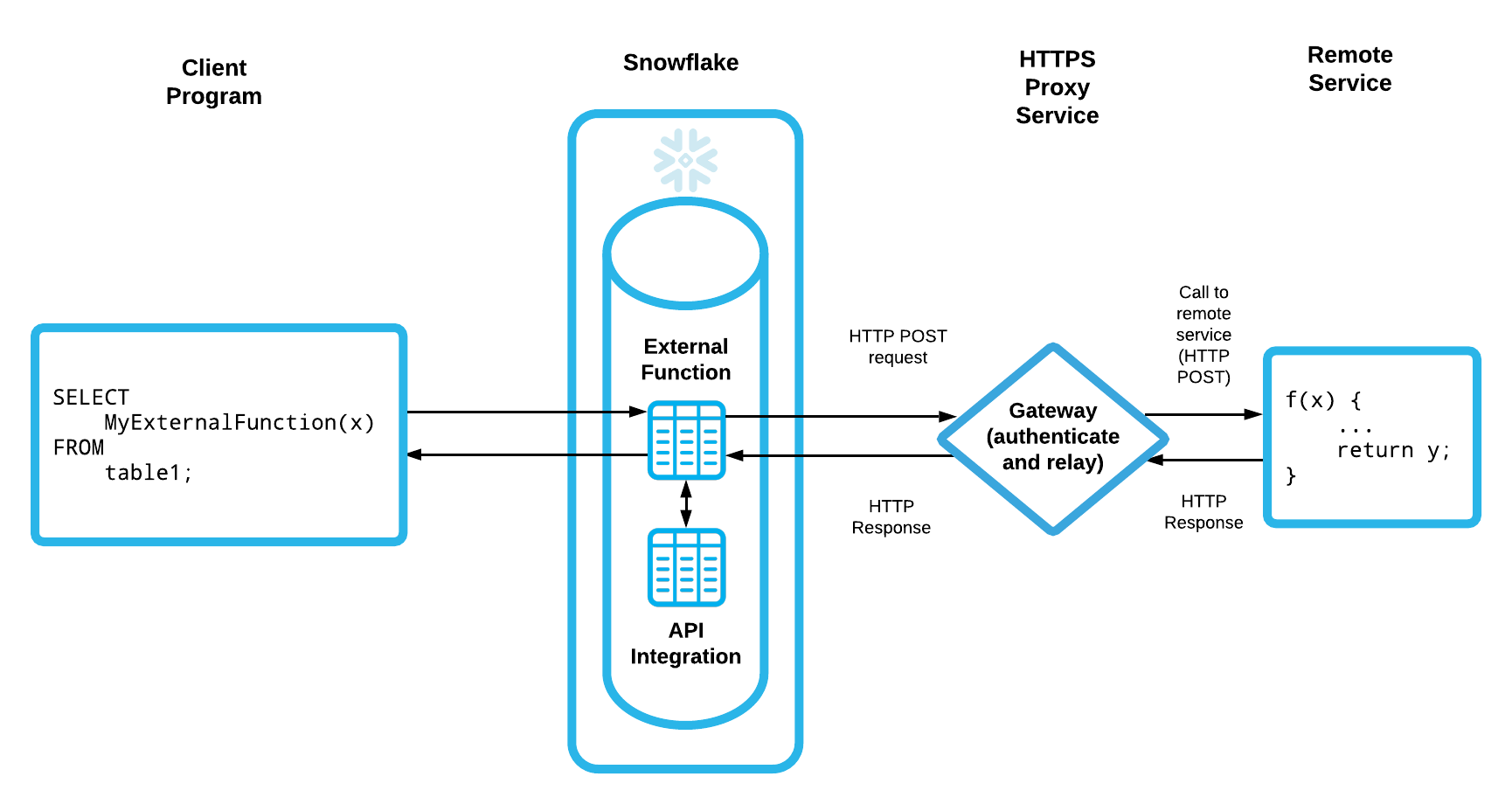
1-- Step 1: Create API integration2CREATE API INTEGRATION my_api_integration3API_PROVIDER = aws_api_gateway4API_AWS_ROLE_ARN = 'arn:aws:iam::123456789:role/my-role'5API_ALLOWED_PREFIXES = ('https://abc123.execute-api.us-east-1.amazonaws.com/')6ENABLED = TRUE;78-- Step 2: Create the external function9CREATE EXTERNAL FUNCTION translate_text(text VARCHAR, target_lang VARCHAR)10RETURNS VARCHAR11API_INTEGRATION = my_api_integration12AS 'https://abc123.execute-api.us-east-1.amazonaws.com/prod/translate';1314-- Step 3: Use like any function15SELECT translate_text(description, 'fr') FROM products;External functions are slower than native UDFs due to network latency. Data leaves Snowflake — consider security implications. They are billed per row processed and have rate limits.
Cheat Sheet
Functions & Procedures Quick Reference
UDFs
TypeLanguagesUsageRightsStored Procedures
LanguagesInvocationDefault rightsCan do DDL/DMLExternal Functions
MechanismTransportPerformancePractice Quiz
Which of the following can a stored procedure do that a UDF cannot?
What is the default execution mode for stored procedures?
How do you call a UDTF in a query?
Flashcards
What languages can Snowflake UDFs be written in?
SQL, JavaScript, Python, and Java. JavaScript UDFs receive column names in UPPERCASE. Python UDFs require RUNTIME_VERSION and HANDLER parameters.
What is the difference between a UDF and a stored procedure?
UDFs return values and are used in queries (SELECT/WHERE). Stored procedures are called with CALL, can execute DDL/DML, and manage transactions. UDFs cannot modify data; stored procedures can.
What are Owner's Rights vs Caller's Rights?
Owner's Rights (default): procedure runs with the owner's privileges — caller does not need direct access to underlying objects. Caller's Rights (EXECUTE AS CALLER): runs with the caller's privileges. Only applies to stored procedures — UDFs are always caller's rights.
How do external functions work in Snowflake?
Snowflake sends data via HTTPS to an API Gateway (AWS/Azure/GCP), which forwards to a cloud function (Lambda/Azure Function). Results are returned the same way. Requires an API Integration object. Data leaves Snowflake, so consider security.
When should you use a UDTF instead of a UDF?
Use a UDTF when you need to return multiple rows per input row (one-to-many). UDFs return exactly one value per input row (one-to-one). UDTFs are called with TABLE() in the FROM clause.
Resources
Next Steps
Reinforce what you just read
Study the All flashcards with spaced repetition to lock it in.